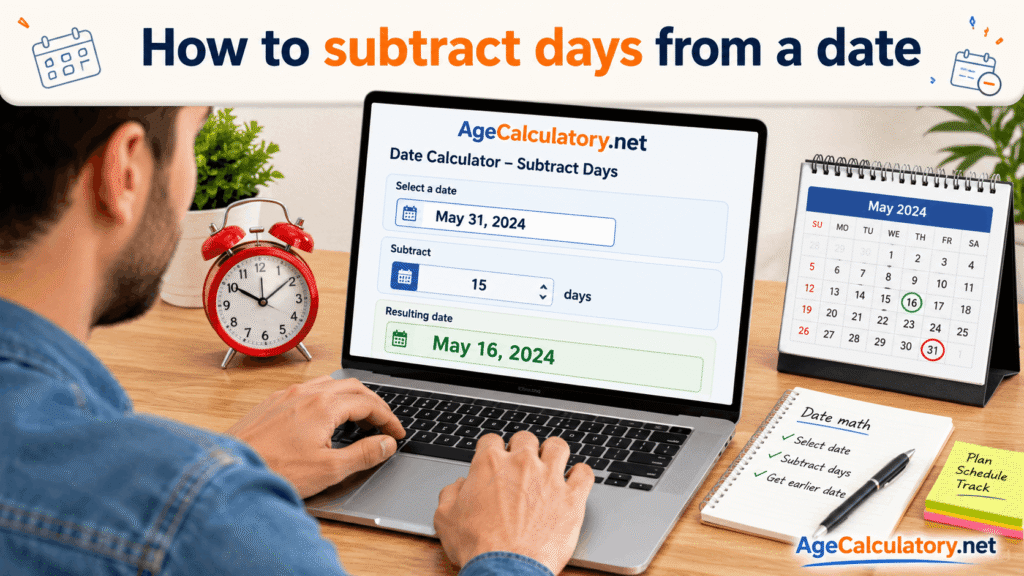
Subtracting days from a date means finding an earlier date. You start from one date and move backward by a selected number of days.
This is useful when you want to find old deadlines, previous event dates, record dates, planning dates, or the date before a certain number of days. It is also useful in school, office, travel, and personal planning.
What does subtracting days from a date mean?
Subtracting days means going back in the calendar. If today is 10 June and you subtract 5 days, the result will be 5 June.
This calculation is simple for small numbers. But it can become confusing when the date range crosses months or years.
Why people subtract days from a date
People subtract days from a date to find past dates. For example, you may want to know the date 30 days before an exam, 7 days before a trip, or 90 days before a deadline.
It is also useful for record checking. You can find when a period started if you know the ending date and duration.
Simple example
Suppose the date is 20 March 2026. If you subtract 10 days, the result will be 10 March 2026.
This is easy because both dates are in the same month. But if you subtract 30, 60, or 90 days, the result may go into the previous month or previous year.
Why manual subtraction can be hard
Manual subtraction is not always simple because months have different lengths. January has 31 days, February has 28 or 29 days, and April has 30 days.
If the calculation crosses February, leap years can also matter. A date calculator handles these calendar rules automatically.
Subtract 7 days from a date
Subtracting 7 days means going back exactly one week. If the selected date is Friday, the date 7 days before it will also be Friday.
This is useful for weekly planning, reminders, health tracking, study schedules, and task review dates.
Subtract 30 days from a date
Subtracting 30 days is useful for finding a date about one month earlier. However, 30 days is not exactly the same as one calendar month in all cases.
For example, subtracting 30 days from 31 March will not always feel like subtracting one month. This is why day-based and month-based calculations should not be mixed carelessly.
Subtract 60 or 90 days from a date
Subtracting 60 or 90 days is useful for official periods, notices, preparation plans, and long-term deadlines. Many forms and processes use time ranges like 60 days or 90 days.
A calculator is very helpful here because the date range may cross multiple months. It can also cross into the previous year.
Subtracting days for preparation plans
If your exam is on a fixed date, you can subtract days to find when to start preparation. For example, subtracting 90 days from the exam date can give you a good starting point.
This helps you plan with a clear timeline. It is better than guessing because the date is exact.
Subtracting days for records
Sometimes you know the end date and the number of days, but you do not know the start date. In that case, subtracting days can help.
For example, if a project ended today and lasted 45 days, subtracting 45 days from today can help estimate the start date.
Calendar days vs working days
When subtracting days, you must know whether you are subtracting calendar days or working days. Calendar days include every day.
Working days usually skip weekends and holidays. This difference is important for office deadlines, business processing, and delivery dates.
Inclusive counting
Some situations use inclusive counting, where the selected date is counted as part of the period. This can change the result by one day.
For normal date subtraction, you usually move backward by full days. But for official or business use, always follow the rule given in the instruction.
Common mistakes
One common mistake is subtracting months instead of days. For example, 30 days before a date is not always exactly one month before.
Another mistake is forgetting leap years. If the date range crosses February in a leap year, the result can be affected.
Use AgeCalculatory.net
You can use AgeCalculatory.net date tools to subtract days from a date. Enter the selected date and the number of days you want to go back.
This is useful for deadlines, preparation plans, old records, travel planning, and event schedules. It saves time and avoids calendar mistakes.
Frequently asked questions
How do I subtract days from a date?
Choose a date and subtract the required number of days. A date calculator can show the earlier date quickly.
Can I subtract 30 days from a date?
Yes, you can subtract 30 days from any date. The result may not always be the same as subtracting one calendar month.
Are weekends counted when subtracting days?
If you subtract calendar days, weekends are counted. If you subtract working days, weekends may be skipped.
Can I find the date 90 days before today?
Yes, you can subtract 90 days from today to find the past date.
Do leap years affect subtracting days?
Yes, leap years can affect date calculations when February 29 is included in the date range.
Conclusion
Subtracting days from a date is useful when you need to find a past date. It helps with planning, records, deadlines, preparation schedules, and event timelines.
The calculation may look simple, but it can become confusing when months, years, and leap years are involved. That is why using a date calculator is safer than manual counting.
Use AgeCalculatory.net to subtract days from a date and find past dates quickly.