A deadline date is the final date by which something should be completed or submitted. It may be for a form, project, payment, assignment, exam application, office task, or document submission.
Calculating a deadline date correctly is important because one small date mistake can cause late submission. A date calculator helps you find the final date without manual counting confusion.
What is a deadline date?
A deadline date is the last allowed date for an action. For example, if a form must be submitted within 15 days, the deadline date is the final date before the time period ends.
Deadline dates are common in schools, offices, government forms, banks, online applications, and business tasks. They help people follow a clear time limit.
What details you need
To calculate a deadline date, you need a start date and a number of days. The start date is the date from which the deadline period begins.
You also need to know whether the deadline uses calendar days or business days. This is very important because the final date can change.
Basic formula
The basic idea is simple:
Deadline date = Start date + allowed number of days
For example, if the start date is 1 June and the allowed period is 10 days, you add 10 days to find the deadline date.
Simple example
Suppose the start date is 1 June 2026 and the deadline period is 15 calendar days. You add 15 days to the start date.
The final deadline date will be based on normal calendar day counting. If the rule uses inclusive counting, the deadline may change by one day.
Calendar day deadline
A calendar day deadline counts every day. Weekends and holidays are included in the counting.
For example, if you have 10 calendar days from Monday, Saturday and Sunday are also counted. This type of deadline is common in general instructions and some official notices.
Business day deadline
A business day deadline usually counts only working days. Weekends and holidays may be skipped.
For example, 10 business days can take around two calendar weeks. This is common in banks, companies, service processing, and office workflows.
Inclusive deadline counting
Some deadline rules count the start date as day one. This is called inclusive counting.
For example, if an event starts on Monday and lasts 5 days including Monday, the final day is Friday. But if you add 5 full days after Monday, the result can be Saturday.
Why deadline rules must be read carefully
Different organizations use different rules. Some count from the next day, while some count from the same day.
Some use calendar days, and some use working days. So before calculating, always read the exact wording in the notice or instruction.
Deadline for forms
Forms often mention a submission period like 7 days, 15 days, 30 days, or 45 days. You can add those days to the starting date to find the final date.
If the form is important, do not wait until the last day. It is better to submit early to avoid internet, payment, or document issues.
Deadline for payments
Payment deadlines may use calendar days or due dates. If a bill says payment is due after 30 days, you can calculate the future date from the bill date.
But late fees may depend on the company’s rule. Always check whether the due date includes holidays or grace periods.
Deadline for projects
Project deadlines are often based on working days. If a team works only Monday to Friday, weekends may not be counted in the actual work plan.
Still, the final project delivery date may be a calendar date. This is why project managers should clearly define the counting method.
Common mistakes
One common mistake is adding business days as if they are calendar days. This can make the final date too early.
Another mistake is ignoring inclusive counting. If the start date is counted as day one, the final date may be one day earlier than expected.
Use AgeCalculatory.net
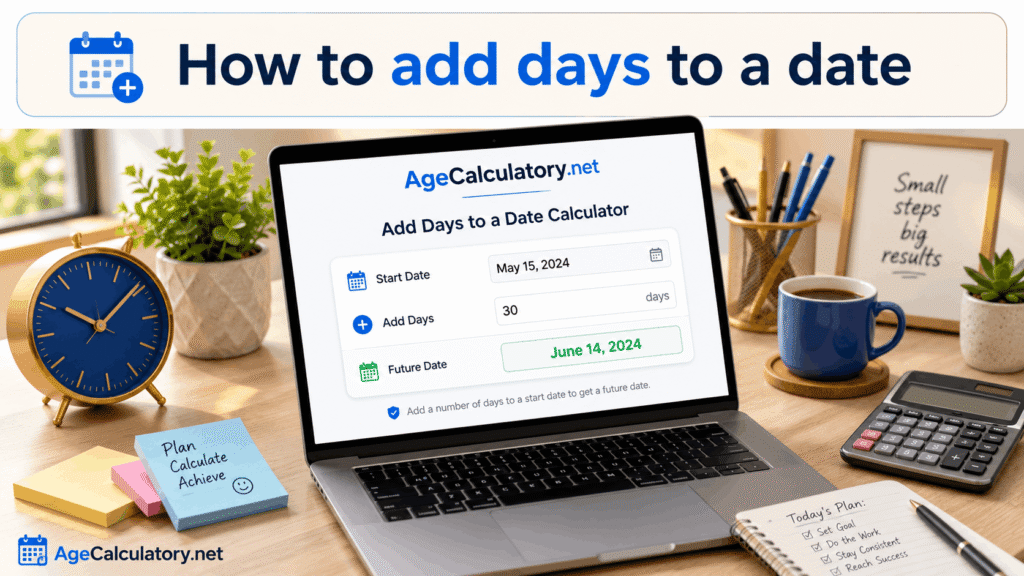
You can use AgeCalculatory.net date tools to calculate deadline dates. Enter the start date and add the number of days to find the future date.
This can help with forms, payments, assignments, projects, reminders, and official work. It is a simple way to avoid manual date counting mistakes.
Frequently asked questions
How do I calculate a deadline date?
Take the start date and add the allowed number of days. A deadline calculator can show the final date quickly.
What is the difference between calendar day deadline and business day deadline?
Calendar day deadlines count every day. Business day deadlines usually skip weekends and holidays.
Should I count the start date?
It depends on the rule. Some deadlines use inclusive counting, while others start counting from the next day.
Can I calculate a 30-day deadline?
Yes, you can add 30 days to the start date to find the deadline date.
Are holidays counted in deadlines?
For calendar day deadlines, holidays are usually counted. For business day deadlines, holidays may be excluded.
Conclusion
Calculating a deadline date is important for forms, payments, assignments, projects, office tasks, and official submissions. A wrong calculation can create stress or even cause late submission.
The correct deadline depends on the start date, number of days, counting method, and whether calendar days or business days are used. Always read the instruction carefully before deciding the final date.
Use AgeCalculatory.net to calculate deadline dates clearly and plan your work before the last day.