Calendar days and business days are common words in date calculations. Many people see these terms in forms, delivery updates, office deadlines, school notices, and official instructions.
Both are used to count time, but they do not always give the same result. If you confuse them, your deadline or date calculation may be wrong by a few days.
What are calendar days?
Calendar days mean all days on the calendar. Monday, Tuesday, Wednesday, Thursday, Friday, Saturday, and Sunday are all counted.
Holidays are also counted as calendar days. Even if an office or school is closed, that date is still part of the calendar.
What are business days?
Business days usually mean normal working days. In many countries and offices, business days are Monday to Friday.
Saturday, Sunday, and public holidays are usually not counted as business days. However, this can change based on country, company, school, or government rules.
Main difference between calendar days and business days
The main difference is simple. Calendar days count every day, but business days usually skip weekends and holidays.
For example, if a task takes 7 calendar days, it may finish in one full week. But if a task takes 7 business days, it may take more than one week because weekends are not counted.
Simple example
Suppose today is Monday and someone says, “Submit within 5 calendar days.” In that case, you count Tuesday, Wednesday, Thursday, Friday, and Saturday.
But if someone says, “Submit within 5 business days,” you usually count Monday to Friday working days only. If Saturday and Sunday come in between, they are skipped.
Why this difference matters
This difference matters in deadlines, delivery dates, office work, school forms, and legal instructions. A small misunderstanding can make you submit something late.
For example, 10 business days can be almost two weeks. But 10 calendar days are just 10 continuous days from the calendar.
Calendar days in delivery
Some delivery services use calendar days, while others use business days. If the delivery says “3 calendar days,” weekends may still be included.
If it says “3 business days,” Saturday, Sunday, and holidays may not be counted. So the delivery may take longer than expected.
Business days in office work
Offices often use business days for deadlines. This is because most office teams do not work on weekends or holidays.
For example, if HR says your document will be checked in 5 business days, it does not usually include Saturday or Sunday. This helps employees understand realistic working time.
Calendar days in countdowns
Countdowns usually use calendar days. Birthdays, anniversaries, exams, trips, and events are counted using all days on the calendar.
If your birthday is after 20 days, weekends are also included in that count. This is because the calendar moves every day, not only on working days.
Business days in official processing
Government offices, banks, and companies often use business days for processing. This is because their teams may work only on official working days.
For example, a bank may say that verification takes 3 to 5 business days. This means weekends and holidays may increase the actual waiting time.
Which one should you use?
Use calendar days when you are counting all real days between two dates. This is good for birthdays, countdowns, travel, events, and general date difference.
Use business days when weekends or holidays should not be counted. This is useful for office tasks, delivery estimates, processing time, and working deadlines.
Common mistake
A common mistake is thinking that business days and calendar days are the same. They are not the same when weekends or holidays fall inside the date range.
Another mistake is not reading the instruction carefully. If a form says calendar days, do not remove weekends unless the rule clearly says so.
Use AgeCalculatory.net
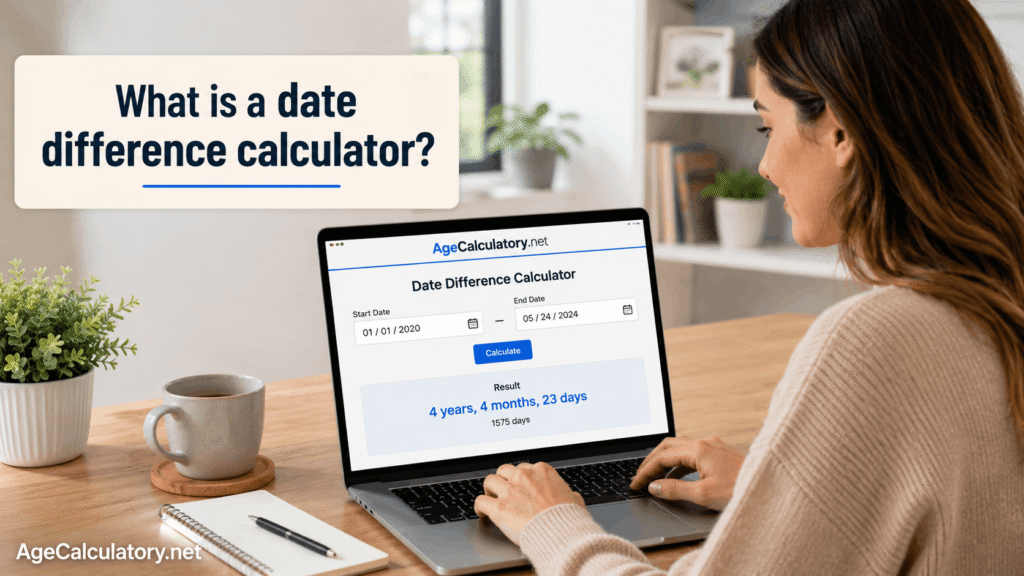
You can use AgeCalculatory.net to calculate date differences clearly. For calendar day calculations, enter the start date and end date to understand the total time gap.
For business day planning, first understand the total date range and then remove weekends or holidays if needed. This helps you avoid confusion while planning deadlines.
Frequently asked questions
Are calendar days and business days the same?
No, they are not the same. Calendar days include every day, while business days usually exclude weekends and holidays.
Are weekends counted in calendar days?
Yes, weekends are counted in calendar days. Saturday and Sunday are normal calendar dates.
Are weekends counted in business days?
Usually no, weekends are not counted in business days. But this can change based on the company or country.
Which is better for deadlines?
It depends on the rule. Office and processing deadlines often use business days, while general event countdowns use calendar days.
Can business days include holidays?
Usually holidays are not counted as business days. But the final rule depends on the organization or country.
Conclusion
Calendar days and business days are both useful, but they are used for different purposes. Calendar days count every day, while business days usually count only working days.
If you are planning birthdays, events, or countdowns, calendar days are usually enough. If you are planning office work, delivery, bank processing, or official deadlines, business days may be more useful.
Always read the wording carefully before calculating. A simple difference between calendar days and business days can change the final date.