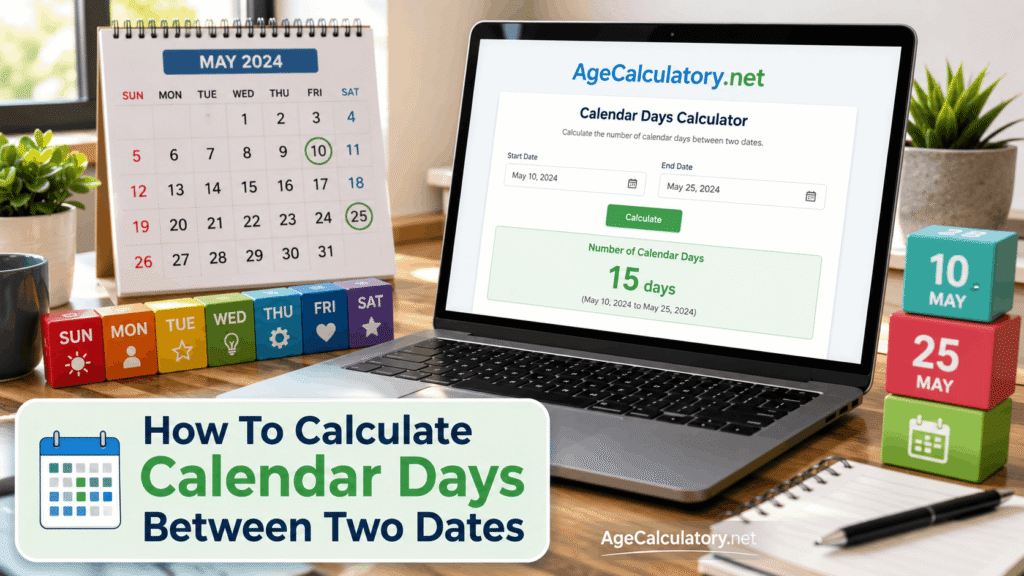
Calendar days mean all days on the calendar, including weekdays, weekends, and holidays. If you are counting calendar days between two dates, you do not remove Saturdays, Sundays, or public holidays.
This is different from working days or business days. Calendar days count every date in the range, which makes them useful for general duration, countdowns, travel periods, event ranges, and simple date difference calculations.
What are calendar days?
Calendar days are all days shown on a calendar. Monday, Tuesday, Wednesday, Thursday, Friday, Saturday, and Sunday are all calendar days.
Holidays are also calendar days. Even if a school, office, or business is closed, the date still exists on the calendar and is counted as a calendar day.
Calendar days vs working days
Calendar days include every day. Working days usually exclude weekends and sometimes holidays.
For example, from Monday to Sunday, there are 7 calendar days. But if working days are Monday to Friday, there are only 5 working days.
What details you need
You need a start date and an end date. The calculator uses these two dates to find the total calendar day difference.
Example:
Start date: 1 June 2026
End date: 10 June 2026
The calculator checks how many calendar days are between these two dates.
Simple example
Suppose the start date is 1 June 2026 and the end date is 10 June 2026. The normal date difference is 9 days if the start date is not counted as a completed day.
If you use inclusive counting and count both the start and end dates, the result is 10 calendar days. This is why counting method matters.
Normal calendar day difference
Normal calendar day difference counts the gap between dates. For example, from 1 June to 2 June, the difference is 1 day.
This method is commonly used in date difference calculators. It shows how many full days pass from the start date to the end date.
Inclusive calendar days
Inclusive calendar days count both the start date and the end date. This method is sometimes used for travel, events, leave periods, rentals, or official ranges.
For example, if an event runs from 1 June to 3 June, inclusive counting gives 3 calendar days. Normal difference counting gives 2 days.
Calendar days for countdowns
Countdowns often use calendar days. If your birthday is 30 days away, the countdown includes all days between today and your birthday.
Weekends and holidays are not removed because countdowns are based on real calendar time. This makes calendar day counting useful for birthdays, exams, trips, and events.
Calendar days for travel
Travel plans often use calendar days. If your trip starts on Monday and ends on Friday, you may describe it as a 5-day trip if both start and end days are included.
However, hotel nights are different from calendar days. A 5-day trip may include 4 nights, depending on arrival and departure times.
Calendar days for deadlines
Some deadlines use calendar days. For example, a form may say “submit within 30 calendar days.” This means weekends and holidays are usually included unless the rule says otherwise.
This is different from “30 working days,” which usually excludes weekends. Always read the wording carefully.
Calendar days for events
Events often use calendar days when they span multiple dates. A festival from 1 January to 5 January may be called a 5-day event if inclusive counting is used.
The important thing is to know whether the start and end dates are included. This can change the result by one day.
Calendar days for age and date difference
Age and date difference calculations often use normal calendar day difference. For age in days, the calculator counts full days passed from birth date to target date.
This is why a person born today has completed 0 days today. After one full day passes, the person is 1 day old.
Why weekends and holidays are included
Weekends and holidays are included because they are still calendar dates. Calendar days measure time as it passes on the calendar, not business activity.
If you want to exclude weekends or holidays, you need working days or business days instead. Calendar days are the broader count.
Common mistakes
One common mistake is confusing calendar days with working days. If a rule says calendar days, do not remove weekends unless the rule clearly says so.
Another mistake is not checking inclusive counting. Some situations count both the start and end dates, while normal date difference counts the gap between them.
Use AgeCalculatory.net
You can use AgeCalculatory.net to calculate calendar days between two dates. Enter the start date and end date, and the tool can help show the date difference clearly.
This is useful for countdowns, events, travel, age in days, project duration, and personal records. It makes date counting simple and clear.
Frequently Asked Questions
What are calendar days?
Calendar days are all days on the calendar, including weekdays, weekends, and holidays.
Are weekends included in calendar days?
Yes. Weekends are included in calendar days.
Are holidays included in calendar days?
Yes. Holidays are included unless a rule says they should be excluded.
What is the difference between calendar days and working days?
Calendar days include all days. Working days usually exclude weekends and holidays.
Does inclusive counting change calendar day results?
Yes. Inclusive counting counts both the start and end dates, so the result can be one day higher than normal difference counting.
Conclusion
Calendar days between two dates include every day on the calendar. This means weekdays, weekends, and holidays are all counted.
This type of calculation is useful for countdowns, travel periods, event ranges, deadlines, date differences, and age in days. The main thing to check is whether you need normal date difference or inclusive counting.
Use AgeCalculatory.net to calculate calendar days between two dates quickly and avoid manual counting mistakes.