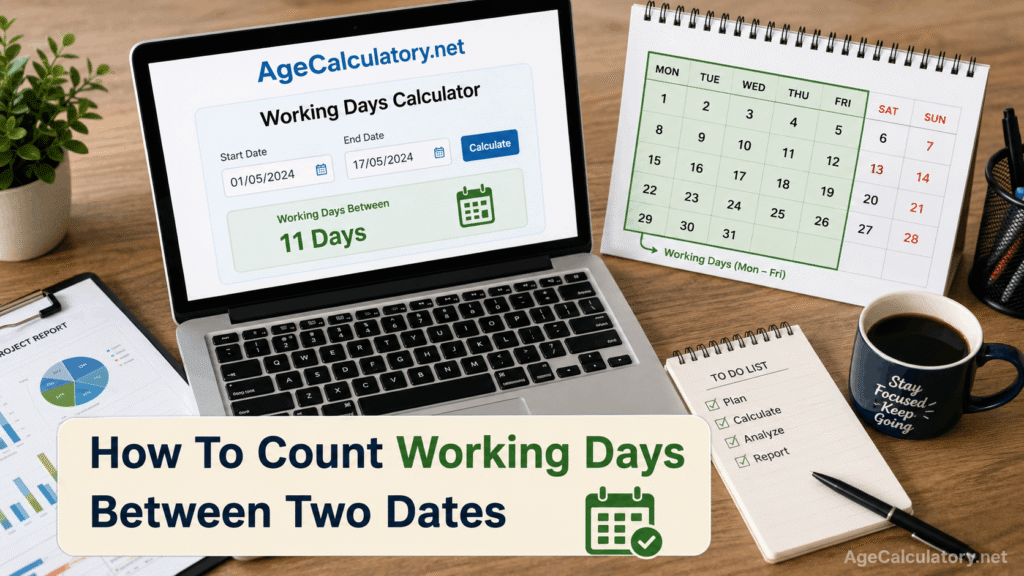
Working days are the days when people usually work, study, or run business activities. In many places, Monday to Friday are working days, while Saturday and Sunday are weekends.
Counting working days between two dates is useful for office deadlines, project planning, leave calculation, delivery estimates, school schedules, and business tasks. It is different from counting total calendar days because weekends and sometimes holidays are excluded.
What are working days?
Working days are days that are counted as normal work days. For many offices, working days are Monday, Tuesday, Wednesday, Thursday, and Friday.
However, working days can change based on country, company, school, or industry. Some businesses work on Saturdays, and some countries have different weekend patterns.
Working days vs calendar days
Calendar days include every day in the date range. This means weekdays, weekends, and holidays are all counted.
Working days usually exclude weekends. In some calculations, public holidays are also excluded. This is why working days are often fewer than calendar days.
What details you need
You need a start date and an end date. You also need to know which days should be counted as working days.
Example:
Start date: 1 May 2026
End date: 10 May 2026
Weekend days: Saturday and Sunday
The calculator counts only the weekdays between the dates.
Simple example
Suppose the date range is Monday to Friday in the same week. If all five days are normal work days, the working day count is 5 days.
If the date range is Monday to Sunday, the calendar days are 7 days. But the working days are usually 5 days if Saturday and Sunday are excluded.
Example excluding weekends
Suppose you want to count working days from 1 June 2026 to 7 June 2026. If 1 June is Monday, the range includes Monday to Sunday.
The working days are Monday, Tuesday, Wednesday, Thursday, and Friday. Saturday and Sunday are excluded, so the result is 5 working days.
What about holidays?
Holidays are different from weekends. A weekday can still be a holiday, depending on the country or organization.
If a public holiday falls on a weekday, some working day calculators can exclude it. For accurate business use, you should include the holiday list for your country or company.
Working days for office deadlines
Office deadlines often use working days. For example, a task may be due in 10 working days.
This does not mean 10 calendar days. If weekends are excluded, 10 working days may take around 2 calendar weeks.
Working days for delivery estimates
Delivery companies may use business days to estimate shipping time. For example, “delivery in 5 business days” usually means weekends are not counted.
If holidays occur during that time, delivery may take longer. This is why business day calculation is useful.
Working days for leave calculation
Leave calculation may use working days or calendar days depending on company policy. Some organizations count only working days, while others may include weekends in long leave periods.
Always check your organization’s rule. A calculator can help, but the official policy decides the final count.
Working days for school schedules
Schools may also count working days for academic schedules. Weekends and holidays are usually excluded.
This can help count teaching days, exam preparation days, or days left before a school event.
Manual method
To count manually, list all dates between the start date and end date. Remove Saturdays and Sundays if your weekend is Saturday-Sunday.
Then remove public holidays if needed. Count the remaining days as working days.
Why manual counting is difficult
Manual counting can become difficult for long date ranges. You may miss weekends, forget holidays, or count the start and end date incorrectly.
A working days calculator can do this faster. It is especially useful for long projects, official planning, or repeated calculations.
Inclusive working days
Some calculations include both start and end dates if they are working days. Other calculations count only the days after the start date.
This can change the result. If you are calculating for office, delivery, or legal use, confirm whether inclusive counting is required.
Common mistakes
One common mistake is treating calendar days and working days as the same. They are not the same if weekends are excluded.
Another mistake is forgetting public holidays. If holidays matter for your purpose, they must be removed from the working day count.
Use AgeCalculatory.net
You can use AgeCalculatory.net date tools to understand date differences and plan time ranges. If you are counting working days manually, first calculate the total date range and then exclude weekends or holidays as needed.
A dedicated working days calculator can be useful if your site includes this feature. It can help users plan business deadlines, school days, delivery timelines, and office tasks.
Frequently Asked Questions
What are working days?
Working days are the days usually counted as work days, often Monday to Friday.
Are weekends counted as working days?
Usually no. Saturday and Sunday are commonly excluded, but this depends on the organization or country.
Are holidays counted as working days?
Usually no, if the holiday is officially non-working. But this depends on the rule being followed.
How do I count working days manually?
Count all dates in the range, remove weekends, remove holidays if needed, and count the remaining days.
Is working days count the same as calendar days?
No. Calendar days include all days, while working days usually exclude weekends and holidays.
Conclusion
Counting working days between two dates is useful for business, school, delivery, project, and leave planning. It gives a more practical result than calendar days when weekends and holidays should not be counted.
The correct result depends on your rules. You need to know the start date, end date, weekend pattern, holiday list, and whether inclusive counting is required.
Use AgeCalculatory.net date tools to understand date ranges clearly, and use working day logic when your planning depends on business days.