Most people know their age in years. Some people check their age in months or days too.
Age in weeks is another nice way to look at your age. It breaks your life into 7-day blocks, so the number feels clear and easy to understand.
For example, a 25-year-old person has lived more than 1,300 weeks. That sounds different from 25 years because it shows how many full weeks have passed since birth.
What does weeks old mean?
Weeks old means the total number of weeks passed from your date of birth to a selected date.
The selected date is usually today. It can also be a school admission date, exam cut-off date, job application date, birthday date, or any future date you want to check.
One week has 7 days. So, when you calculate age in weeks, you are counting how many full 7-day periods have passed since your birth date.
Why people calculate age in weeks
People calculate age in weeks for babies, pregnancy records, child growth tracking, personal milestones, and birthday planning.
For babies, weeks are very common. Parents may say a baby is 2 weeks old, 6 weeks old, or 12 weeks old because a baby changes fast in the first few months.
Weeks are also easier to read than a very large day count. Saying “1,300 weeks old” feels cleaner than saying “9,100 days old.”
How to calculate age in weeks
To calculate your age in weeks, you need 2 dates: your date of birth and the target date.
First, count the total number of days between those 2 dates. Then divide that number by 7.
The basic logic is:
Age in weeks = Total days lived ÷ 7
If a few days remain after dividing by 7, the result can be shown as weeks and days.
Simple example
Let’s take a small example.
Date of birth: 1 January 2024
Target date: 29 January 2024
From 1 January to 29 January, there are 28 days.
Now divide 28 by 7:
28 ÷ 7 = 4 weeks
So the age is 4 weeks.
Example with extra days
Now take another example.
Date of birth: 1 January 2024
Target date: 31 January 2024
From 1 January to 31 January, there are 30 days.
Now divide 30 by 7:
30 ÷ 7 = 4 weeks and 2 days
So the age is 4 weeks and 2 days.
This format is very common for babies and short age periods.
Age in weeks for babies
Age in weeks is very helpful during the first few months of a baby’s life.
A baby can be 1 week old, 4 weeks old, 8 weeks old, or 12 weeks old. These numbers help parents track growth more clearly.
A few weeks can make a big change in a baby’s sleep, feeding, weight, and movement. That is why many parents use weeks before switching to months.
Age in weeks for pregnancy
Pregnancy is usually counted in weeks.
You may hear people say 12 weeks pregnant, 20 weeks pregnant, or 36 weeks pregnant. This helps doctors and parents track the baby’s growth before birth.
After birth, weeks can still be used for newborn age. The idea is the same: count full 7-day periods from a starting date.
Age in weeks for personal milestones
Some people check age in weeks for fun.
You can find when you complete 500 weeks, 1,000 weeks, or 2,000 weeks of life.
These milestones feel different from normal birthdays. They are based on full weeks from your date of birth, so they can fall on a different date every time.
Age in weeks and age in days
Age in days gives the full number of days you have lived.
Age in weeks groups those days into sets of 7.
For example, 70 days means 10 weeks. If the total is 73 days, that becomes 10 weeks and 3 days.
Days give the full count. Weeks make the number easier to read.
Age in weeks and age in months
Weeks and months are counted in different ways.
A week always has 7 days. A month can have 28, 29, 30, or 31 days.
That is why weeks feel more fixed. A 4-week period is always 28 days, but one calendar month can be longer or shorter.
For babies, weeks are usually clearer during the first 2 or 3 months. After that, many people start using months.
Rough method to calculate age in weeks
A rough method is to multiply your completed age in years by 52.
For example:
25 × 52 = 1,300 weeks
This gives a quick estimate because one year is usually treated as 52 weeks.
The real number can be slightly different because a year has 365 days, and 52 weeks make only 364 days. Leap years add extra days too.
Better way to calculate age in weeks
The cleaner way is to use the full date of birth and the correct target date.
For example, use:
15 May 1999
Then select the target date, like:
8 May 2026
The calculator counts the total days first. Then it converts those days into weeks and remaining days.
This gives a more accurate result than multiplying years by 52.
How leap years affect age in weeks
A normal year has 365 days. A leap year has 366 days.
That extra day can change the total day count. Since weeks are made from days, leap years can affect the final week result too.
For example, if your life period includes many leap years, those extra days may add up. They may create extra remaining days after the full weeks are counted.
Common mistakes while calculating age in weeks
One common mistake is multiplying only age in years by 52 and treating it as the final answer.
For example, a person who is 25 years and 6 months old has lived more than 1,300 weeks. The extra 6 months add many more weeks.
Another mistake is forgetting the remaining days. If someone is 100 days old, the result is 14 weeks and 2 days because 14 weeks equals 98 days.
A third mistake is using the wrong target date. If you are checking a form or rule, use the date mentioned in that form.
Where age in weeks can be useful
Age in weeks can be useful for baby tracking, pregnancy records, health notes, birthday milestones, and personal curiosity.
It also helps when days feel too many and months feel too wide.
For example, saying a baby is 10 weeks old gives a clear idea of age during the early months.
Use AgeCalculatory.net
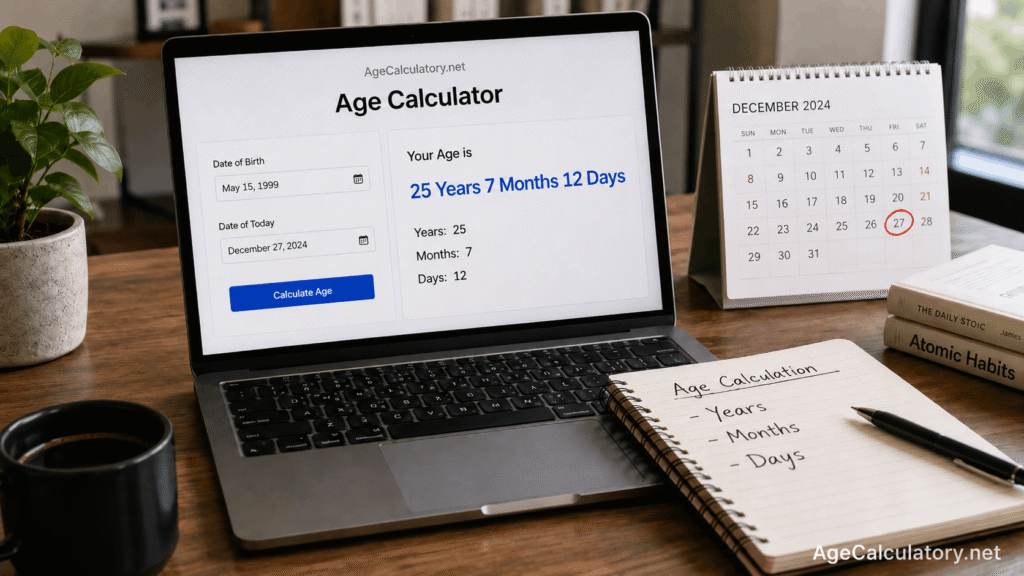
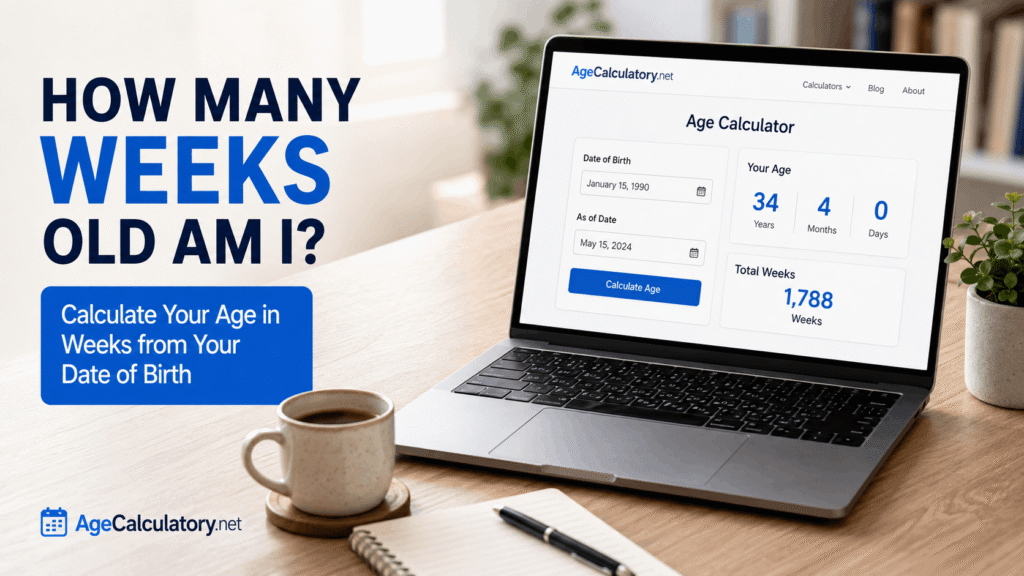
You can use AgeCalculatory.net to calculate your age quickly.
Enter your date of birth and choose the target date. The tool can show your age in years, months, and days.
If total weeks are available in the result, you can also check exactly how many weeks old you are.
Quick tip before you calculate
Check the date format before entering your date of birth.
Some websites use day-month-year. Some websites use month-day-year.
For example, 05/10/2024 can mean 5 October 2024 or 10 May 2024, depending on the format.
Use a date picker when possible. It helps avoid silly date mistakes.
Frequently asked questions (FAQs)
How many weeks old am I?
You can find how many weeks old you are by counting the total days from your date of birth to today, then dividing the days by 7.
How do I calculate age in weeks?
First, calculate the total number of days between your birth date and target date. Then divide that number by 7.
How many days are in one week?
One week has 7 days.
Can I calculate my baby’s age in weeks?
Yes. Enter the baby’s date of birth and today’s date. The calculator can show the baby’s age in weeks and days.
Does leap year affect age in weeks?
Yes. Leap years add extra days, and those days can affect the total week count.
Is age in weeks useful for school admission?
School admission usually uses years, months, and days. Weeks can help for checking, but official rules usually ask for completed age on a cut-off date.
Can I use age in weeks as official proof?
For official proof, use accepted documents like a birth certificate, school certificate, passport, or government ID.
An age calculator result is good for checking and personal use.
Conclusion
Age in weeks tells you how many full 7-day periods have passed since your date of birth. It is useful for babies, pregnancy records, health tracking, personal milestones, and birthday planning.
Use the Age Calculator on AgeCalculatory.net to check your age in years, months, days, and weeks.