Most people say age in years. But age in months gives you a closer look, especially for babies, young children, school forms, and small age gaps.
A 2-year-old child is also around 24 months old. That sounds more exact when you’re tracking growth, admission age, or milestones.
So when someone asks, “How many months old am I?”, they want the total number of months passed from their date of birth to today.
What does months old mean?
Months old means the total completed months between your date of birth and a selected date.
That selected date is usually today. It can also be a future date, exam cut-off date, school admission date, or any date you choose.
For example, if a baby was born on 10 January 2024 and today is 10 July 2024, the baby is 6 months old.
If today is 5 July 2024, the baby hasn’t completed the full 6 months yet. The completed age is 5 months and some days.
Why people calculate age in months
Age in months is common for babies and toddlers.
Parents don’t usually say a baby is “0.5 years old.” They say 6 months old, 9 months old, or 18 months old. That feels clearer.
Schools may also ask age in months for nursery, preschool, or kindergarten admission. Some rules are strict about completed age on a fixed date.
Age in months can also help for child health tracking, vaccination schedules, activity classes, and age-based registrations.
How to calculate age in months
You need 2 dates:
- Date of birth
- Target date
The target date can be today or any date you want.
First, count the full years between the 2 dates. Then convert those years into months. After that, add the remaining completed months.
The basic logic is:
Total months = completed years × 12 + extra completed months
Days are checked at the end. If the day of the target date is before the birth day, one month is usually reduced because the current month is incomplete.
Simple example
Take this example.
Date of birth: 15 May 2020
Target date: 15 May 2026
From 15 May 2020 to 15 May 2026, there are 6 full years.
Now convert years into months:
6 × 12 = 72 months
So the person is 72 months old.
Example with extra months
Now take another example.
Date of birth: 15 May 2020
Target date: 20 August 2026
From 15 May 2020 to 15 May 2026, there are 6 full years.
That gives:
6 × 12 = 72 months
From 15 May 2026 to 15 August 2026, there are 3 full months.
So the total age is:
72 + 3 = 75 months
The extra 5 days are separate. The completed age in months is 75 months.
Example when the month is incomplete
Here’s where people get confused.
Date of birth: 15 May 2020
Target date: 10 August 2026
From May 2020 to August 2026 looks like 75 months at first.
But the target day is 10, and the birth day is 15. The August month is still incomplete.
So the completed month count is 74 months.
Those remaining days can be shown separately.
Age in months for babies
For babies, months matter a lot.
A baby can be 1 month old, 3 months old, 6 months old, 9 months old, or 12 months old. Each stage feels different because babies change fast.
Parents often use months until the child is at least 2 years old. After that, people usually start using years more often.
Still, months are better when the child is small and every few weeks matter.
Age in months for school admission
Many schools use age rules like “the child should complete 3 years by 1 June” or “the child should complete 4 years by 31 March.”
In this case, don’t calculate age using today’s date. Use the school’s cut-off date.
For example:
Date of birth: 10 April 2022
School cut-off date: 31 March 2026
The child has not completed 4 years on 31 March 2026. The birthday comes after the cut-off date.
That small gap can matter in admission rules.
Age in months for exams and forms
Some forms ask for completed age as of a certain date.
If the form asks for age in months, use the given date carefully. A rough year count can give the wrong answer.
This happens a lot with eligibility checks. The rule may say “age as on 1 January” or “age as on 31 December.”
Use that date as the target date.
Rough method
You can get a rough age in months by multiplying age years by 12.
For example:
25 × 12 = 300 months
This gives the completed months for 25 full years.
But if the person is 25 years and 7 months old, the correct completed age is:
307 months
So rough counting is okay for a quick guess. For forms, use exact dates.
Common mistakes
The most common mistake is counting only the years.
Another mistake is adding the current month even when the birth day hasn’t arrived yet.
For example, from 15 May to 10 August, August is not a completed month. The completed month ends on 15 August.
People also forget cut-off dates. For school, exam, or job forms, the target date matters more than today.
How AgeCalculatory.net can help
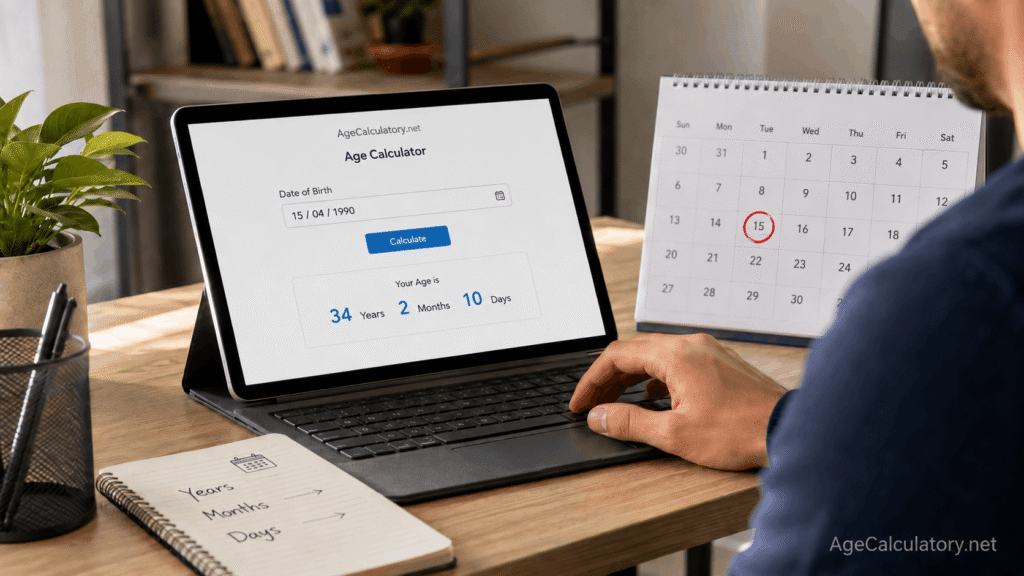
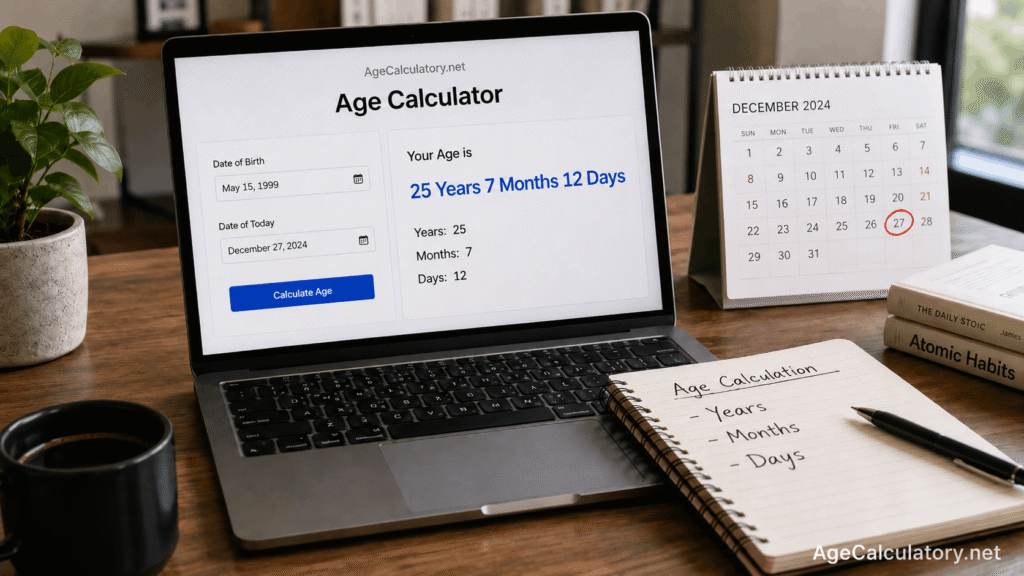
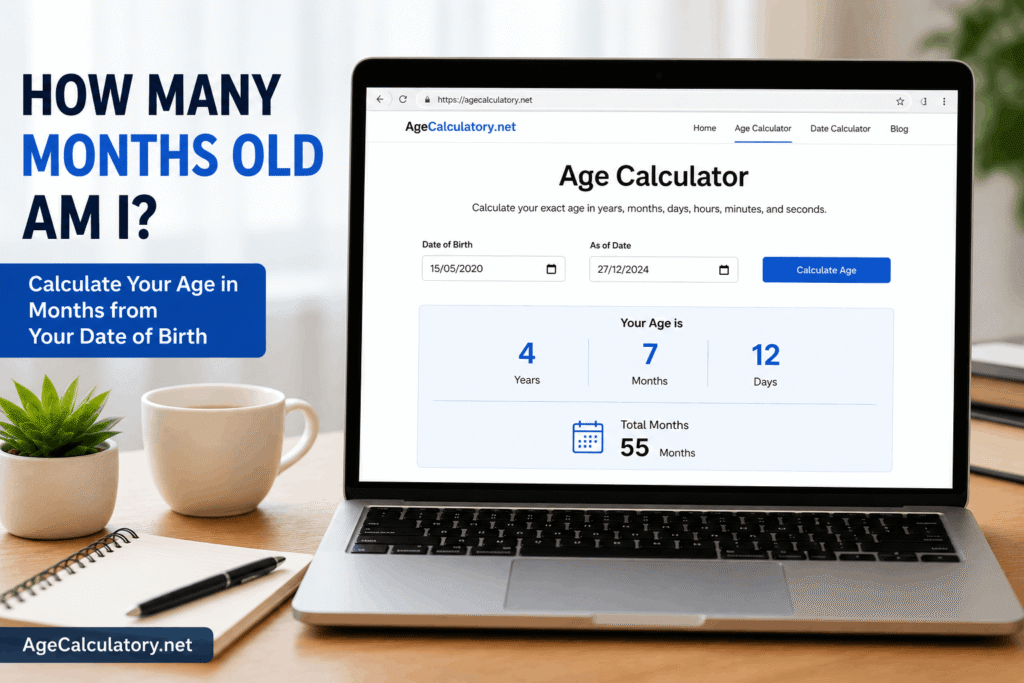
You can use AgeCalculatory.net to calculate age from your date of birth.
Enter the date of birth and target date. The tool can show your age in years, months, and days.
If your calculator has total months, it can also show how many months old you are.
Quick check before you calculate
Check the date format before entering the date.
Some websites use day-month-year. Some use month-day-year.
For example, 05/10/2020 can mean 5 October 2020 or 10 May 2020, depending on the format. That tiny format issue can mess up the result.
Use the date picker when possible. It saves you from silly mistakes.
FAQs
How many months old am I?
You can find it by counting the completed months from your date of birth to today. Use an age calculator for a faster answer.
How do I calculate age in months?
Count completed years first, multiply them by 12, then add the extra completed months.
Does the day of birth matter?
Yes. If the target day is before your birth day, the current month is not complete yet.
Can I calculate my baby’s age in months?
Yes. Enter the baby’s date of birth and today’s date. The calculator will show the baby’s age in months.
Why is age in months useful for children?
Children grow fast in the first few years. Months give a clearer age than years during that stage.
Can I use age in months for school admission?
Yes, but use the school’s cut-off date. Don’t use today’s date unless the school asks for it.
is age in months official proof?
No. A calculator result is for checking. For official proof, use accepted documents like a birth certificate, school certificate, passport, or government ID.
Conclusion
Age in months is useful when years feel too broad.
It helps with babies, school admission, forms, and age-based rules. Enter the full date of birth and the correct target date on Age Calculator on AgeCalculatory.net to get a clean result.