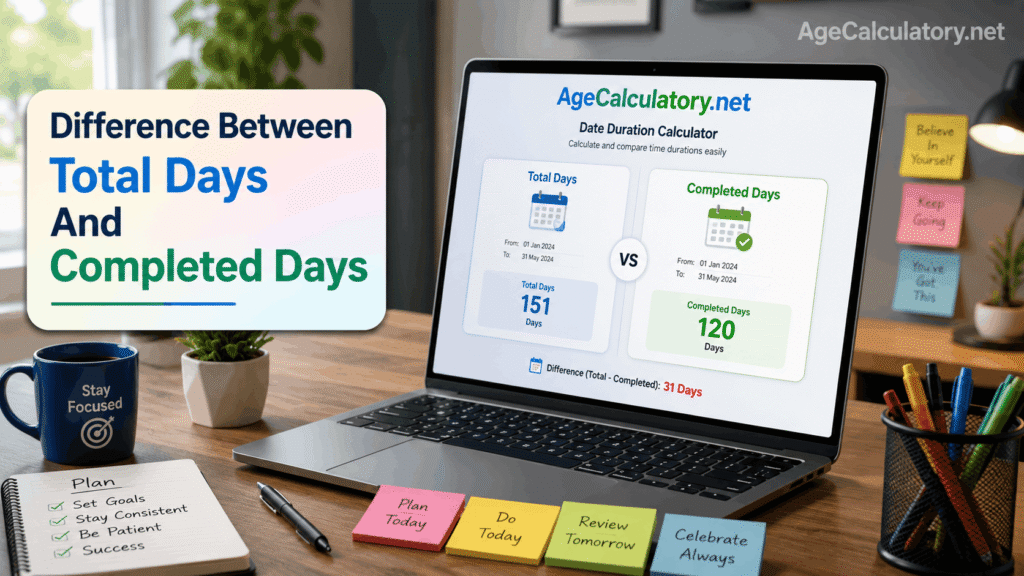
Total days and completed days sound similar, but they can mean slightly different things depending on the calculation. This difference is important when you are counting age, date duration, leave days, deadlines, or event days.
If you understand the difference, you can avoid confusion while using a date calculator. It also helps you choose the correct counting method for your purpose.
What are total days?
Total days usually means the full number of days between two dates. It is often calculated as the date difference from the start date to the end date.
For example, from 1 January to 10 January, the total day difference is usually 9 days. This means 9 full days have passed after 1 January.
What are completed days?
Completed days means the number of full days that have completely passed. It usually does not count a day that has not finished yet.
For example, if a baby was born today, the baby has not completed 1 day yet. After 24 hours, 1 completed day has passed.
Why the difference matters
The difference matters because different situations use different counting methods. Age in days often uses completed days. Some event counts or leave counts may use inclusive days.
If you use the wrong method, your result may be off by one day. This can create confusion in forms, records, or planning.
Simple example
Suppose the start date is 1 January and the end date is 2 January. In normal date difference counting, the result is 1 day.
This means one full day has passed from 1 January to 2 January. But if you count both dates inclusively, then the result may be 2 days.
Normal difference counting
Normal difference counting calculates the gap between two dates. It does not count the start date as a full completed day.
For example:
1 January to 2 January = 1 day
1 January to 10 January = 9 days
This is the common method in many date difference calculators.
Inclusive day counting
Inclusive day counting counts both the start date and the end date. This method is often used for leave, travel, events, hotel stays in some contexts, or official date ranges.
For example:
1 January to 2 January = 2 inclusive days
1 January to 10 January = 10 inclusive days
This method is useful only when the situation requires both dates to be counted.
Total days in age calculation
In age calculation, total days usually means the number of full days lived from date of birth to the target date. The birth date is the starting point, and the target date is the end point.
For example, a person born yesterday has completed 1 day today. A person born today has completed 0 full days today.
Completed days in baby age
Completed days are especially important for babies. If a baby is born today, we do not say the baby completed 1 day immediately.
After one full day passes, the baby is 1 day old. This is why completed days are useful for newborn age and early records.
Total days in project duration
For project duration, total days often means the number of days between the start date and end date. This helps measure how long the project lasted.
If the project started on 1 June and ended on 30 June, you must decide whether the last day is included. Project reports may use normal difference or inclusive counting depending on the rule.
Total days in countdowns
For countdowns, total days usually means days left from today until a future date. If an event is tomorrow, the countdown is usually 1 day.
If the event is today, the countdown is 0 days. This makes countdowns easy to understand.
Why one-day difference happens
A one-day difference usually happens because of counting method. One person may count only completed days, while another person may count both start and end dates.
Neither method is always wrong. The correct method depends on the purpose of the calculation.
Example for leave days
Suppose you take leave from Monday to Wednesday. If your office counts all leave dates, the leave may be 3 days.
But the date difference from Monday to Wednesday is only 2 days. This is why official leave calculations often use inclusive counting.
Example for age
Suppose a person was born on 1 January and today is 2 January. The person has completed 1 day.
We do not count both 1 January and 2 January as 2 days of age. Age is based on completed time passed.
Common mistakes
One common mistake is mixing normal date difference with inclusive counting. This usually creates a one-day mismatch.
Another mistake is not checking the purpose. Age, leave, countdown, and duration may need different counting styles.
Use AgeCalculatory.net
You can use AgeCalculatory.net to calculate date differences and age-related day counts. The tool can help you understand the duration between dates clearly.
When using the result, always think about your purpose. If you need official counting, follow the official rule given by the form, school, office, or organization.
Frequently Asked Questions
What are total days?
Total days usually means the number of days between two dates or the full days counted in a date range.
What are completed days?
Completed days are full days that have passed completely from the start point.
Why do some calculators show one day difference?
This usually happens because one calculator uses normal difference counting and another uses inclusive counting.
Which method is correct?
It depends on the purpose. Age usually uses completed days, while leave or event ranges may use inclusive days.
Does inclusive counting count both dates?
Yes. Inclusive counting counts both the start date and the end date.
Conclusion
Total days and completed days are closely related, but they are not always the same in practical use. The difference usually comes from whether the start date is counted or not.
For age and countdowns, completed day logic is usually easier to understand. For leave, travel, and official date ranges, inclusive counting may sometimes be required.
Use AgeCalculatory.net to calculate date differences clearly, and always choose the counting method based on your exact purpose.