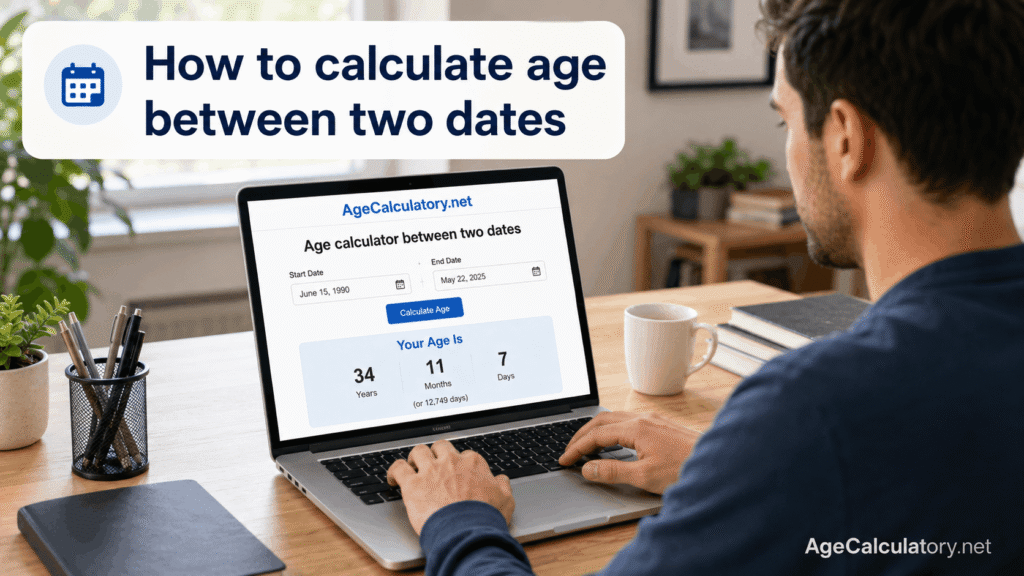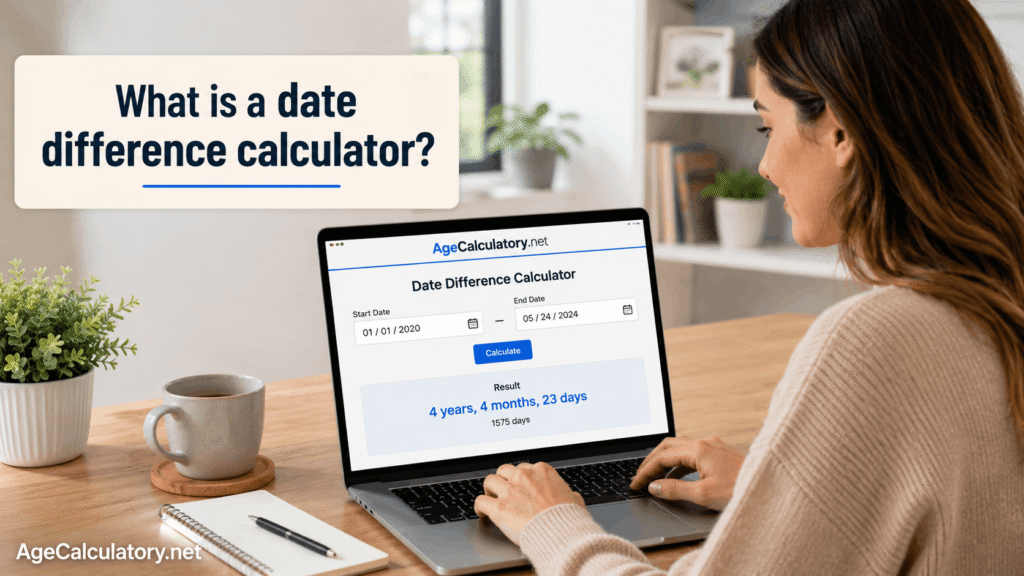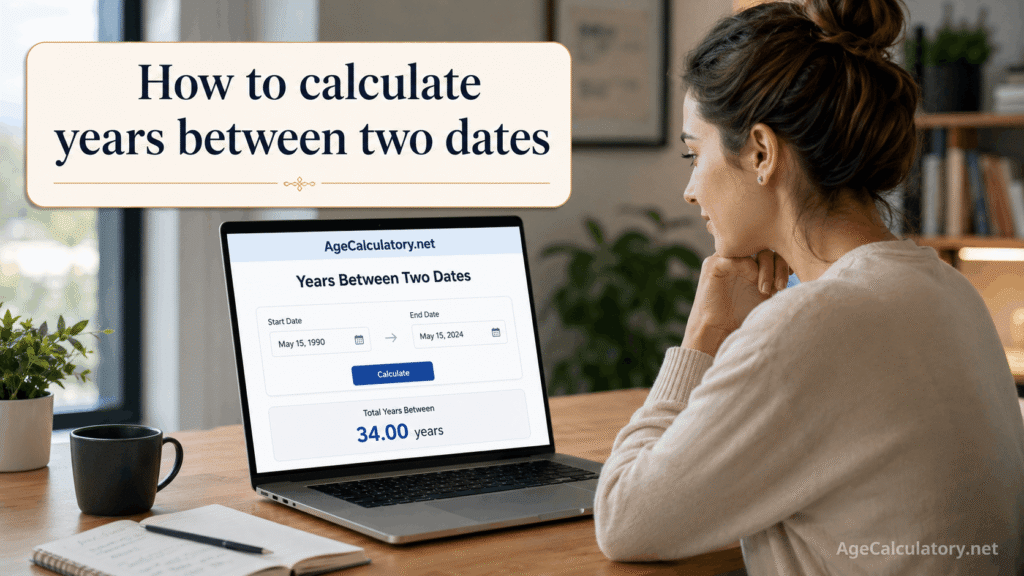
Calculating years between two dates means finding how many full years have passed from a start date to an end date.
This is helpful for age calculation, work experience, school admission, exam eligibility, job forms, service duration, and personal records. Many people make mistakes here because they subtract only the years and forget to check the month and day.
For example, 2026 minus 2000 gives 26. But the real completed years may be 25 if the date has not reached the birthday or start-day yet.
What does years between two dates mean?
Years between two dates means the number of completed years from one date to another date.
For example, from 10 January 2020 to 10 January 2025, there are 5 completed years. The start day and end day match, so the calculation is clean.
But from 10 January 2020 to 5 January 2025, 5 full years are not completed yet. The result is 4 years, with extra months and days.
Dates you need
You need two dates for this calculation. The first one is the start date, and the second one is the end date.
The start date can be a date of birth, joining date, admission date, project start date, or any other starting point. The end date can be today, a leaving date, deadline date, cut-off date, or any target date.
Example:
Start date: 15 May 2000
End date: 27 December 2024
Basic logic
The basic logic is simple:
Completed years = End year – Start year
But this is only the first step. After subtracting the years, you must check the month and day.
If the end date has already crossed the start month and start day, the year count is correct. If the end date has not crossed them yet, subtract 1 year.
Simple example
Take this example.
Start date: 10 January 2020
End date: 10 January 2025
From 10 January 2020 to 10 January 2025, exactly 5 full years have passed.
So the answer is:
5 years
This is the easiest type of year calculation because the month and day are the same.
Example when the date has passed
Now take another example.
Start date: 15 May 2000
End date: 27 December 2024
First subtract the years:
2024 – 2000 = 24 years
Now check the month and day. The end date is 27 December, and the start date is 15 May. Since 15 May has already passed in 2024, the completed year count is correct.
So the result is:
24 years
There are also extra months and days after that, but the completed years are 24.
Example when the date has not passed
Now take this example.
Start date: 15 December 2000
End date: 27 May 2024
First subtract the years:
2024 – 2000 = 24 years
But 15 December has not arrived yet in 2024. So 24 full years are not completed.
You must subtract 1 year.
The completed years are:
23 years
This is the most common place where people make mistakes.
How to calculate years with months and days
Sometimes you need the full result, not just completed years.
Example:
Start date: 15 May 2000
End date: 27 December 2024
From 15 May 2000 to 15 May 2024, there are 24 completed years. From 15 May 2024 to 15 December 2024, there are 7 completed months.
From 15 December 2024 to 27 December 2024, there are 12 days.
So the full difference is:
24 years, 7 months, 12 days
Years between dates for age calculation
Age calculation is one of the most common uses of year difference.
Your date of birth is the start date. The target date can be today or any date mentioned in a form.
If you only subtract birth year from current year, the answer can be wrong. You must check whether the birthday has already passed in the target year.
Years between dates for work experience
Work experience is often shown in years, months, and days.
Example:
Joining date: 10 June 2020
Leaving date: 25 October 2024
The completed years are counted first. Then the remaining months and days are added.
This helps while filling resumes, job forms, experience letters, and service records.
Years between dates for school admission
Schools may ask for a child’s completed age on a cut-off date.
For example, a school may say the child must complete 3 years by 31 March 2026.
If the child was born on 10 April 2023, the child has not completed 3 years by 31 March 2026. The birthday comes after the cut-off date.
So the child’s completed age is still 2 years on that date.
Years between dates for exams
Exam notifications often mention age limits.
For example, an exam may say age should be calculated as on 1 January 2026. In that case, use 1 January 2026 as the end date.
Do not use today’s date if the notification gives a fixed date. The cut-off date decides the age result.
Years between dates for job eligibility
Job applications also use age cut-off dates.
Some jobs may require a minimum age. Some may have a maximum age. Some may give age relaxation for certain categories.
Use your date of birth as the start date and the official cut-off date as the end date. Then compare the result with the rule in the notification.
Manual method
You can calculate completed years manually with 3 steps.
First, subtract the start year from the end year. Second, check whether the start month has passed in the end year. Third, check the day if both months are the same.
If the end date is before the start date in that year, subtract 1 from the year result.
Manual formula
Use this simple logic:
Year difference = End year – Start year
Then check the month and day.
If the end month is before the start month, subtract 1 year.
If the end month is the same but the end day is before the start day, subtract 1 year.
Formula example
Take this example.
Start date: 20 August 2000
End date: 15 August 2026
First subtract the years:
2026 – 2000 = 26
Now check the date. The end date is 15 August, but the start date is 20 August. The full date has not arrived yet.
So subtract 1 year.
The completed years are:
25 years
Why month and day matter
The month and day decide whether a full year is completed.
A person born on 20 August completes one more year only on 20 August each year. On 19 August, that year is still not completed.
This same rule works for work experience, project duration, and other date ranges too.
Why leap years matter
Leap years matter more when you calculate total days, but they can still affect date ranges.
A leap year has 366 days, and February has 29 days. If your date range includes February 29, the total day count changes.
For completed years, leap years usually do not change the year count unless the date is around February 29.
February 29 dates
People born or starting on 29 February may need special care.
For general calculation, the date is handled as part of the real calendar. For official work, the rule may be different depending on the school, exam board, job department, or legal authority.
If the result is for an official purpose, follow the rule given in that document.
Difference between completed years and calendar years
Completed years means full years passed between two exact dates.
Calendar years means the difference between year numbers.
For example, from 31 December 2023 to 1 January 2024, the calendar year changes. But only 1 day has passed.
So the completed year difference is 0 years, even though the year number changed.
Common mistakes
One common mistake is subtracting only the year numbers.
For example, 2026 – 2000 gives 26. But if the full date has not arrived in 2026, the completed years are 25.
Another mistake is using the wrong target date. This happens often with school, exam, and job forms.
A third mistake is mixing date formats. 05/10/2024 can mean 5 October or 10 May, depending on the format.
How to avoid wrong results
Use the full date: day, month, and year.
Check whether the start month and day have passed in the end year. If they have not passed, reduce one year.
For forms and official rules, use the exact date mentioned in the document. A few days can change the answer.
Use AgeCalculatory.net
You can use AgeCalculatory.net to calculate years between two dates quickly.
Enter the start date and end date. The tool can show completed years, months, and days.
If available, you can also check total months, total weeks, and total days between those dates.
Frequently asked questions
How do I calculate years between two dates?
Subtract the start year from the end year. Then check whether the start month and day have already passed in the end year.
Why do I need to check the month and day?
The month and day tell whether the full year is completed. Without checking them, the result may be one year too high.
How many years are between 10 January 2020 and 10 January 2025?
There are 5 completed years between those dates.
How many years are between 20 August 2000 and 15 August 2026?
There are 25 completed years because 20 August has not arrived yet in 2026.
Can I calculate work experience in years?
Yes. Use the joining date as the start date and the leaving date as the end date.
Can I use this for exam eligibility?
Yes. Use your date of birth as the start date and the exam cut-off date as the end date.
Is year difference the same as age?
Age is a type of year difference where the start date is the date of birth. General year difference can use any two dates.
Conclusion
Calculating years between two dates is simple when you check the full date.
Subtract the years first, then check the month and day. If the full date has not arrived yet, reduce 1 year.
Use AgeCalculatory.net to calculate years between dates quickly and get the result in years, months, and days.