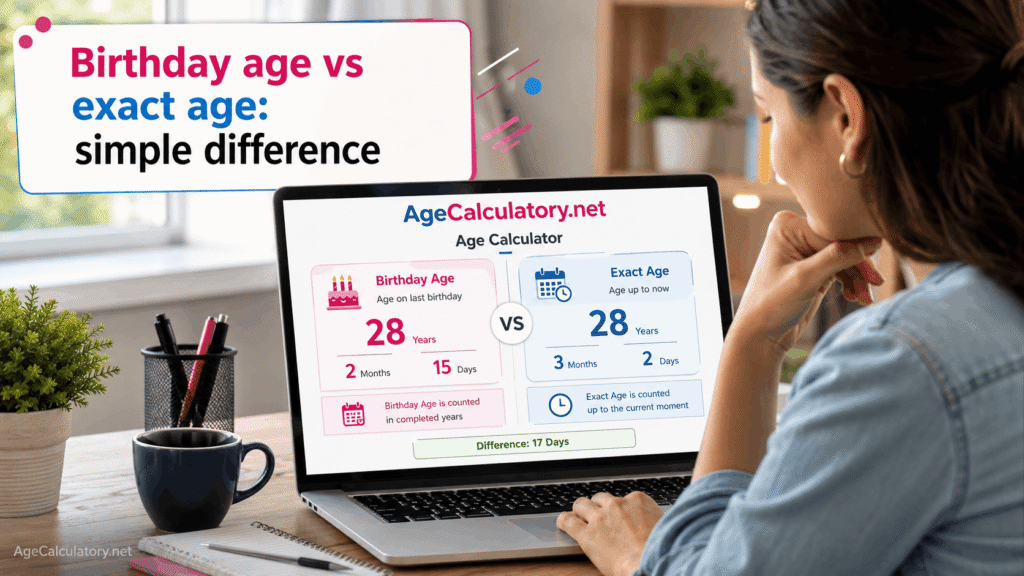
Birthday age and exact age are connected, but they are not exactly the same. Birthday age usually means the completed age on your birthday. Exact age means your full age in years, months, and days on a selected date.
Many people use both terms casually, but the difference matters when you are filling forms or checking eligibility. If you understand the difference, age calculation becomes much easier.
What is birthday age?
Birthday age is the age you complete on your birthday. For example, if you were born on 15 May 2000, you complete 25 years on 15 May 2025. On that birthday, your birthday age is 25 years.
Before your birthday arrives, you have not completed the next age yet. This is why birthday age depends strongly on whether the birthday has already passed in the target year.
What is exact age?
Exact age is your full age from date of birth to a selected date. It includes completed years, completed months, and remaining days. For example, your exact age may be 25 years, 7 months, and 12 days.
Exact age gives more detail than birthday age. It is useful when you want to know your age clearly on today’s date, a cut-off date, or any specific date.
Simple difference
The simple difference is this: birthday age focuses on the age completed on your birthday, while exact age shows your age on any selected date. Birthday age is usually shown only in years. Exact age is usually shown in years, months, and days.
For example, if someone is 25 years, 7 months, and 12 days old, their birthday age is still 25 years. Their exact age includes the extra 7 months and 12 days.
Simple example
Suppose your date of birth is 15 May 2000 and today is 20 July 2026. You completed 26 years on 15 May 2026. So your birthday age is 26 years.
Your exact age on 20 July 2026 is more detailed. It is around 26 years, 2 months, and 5 days. This gives a clearer picture of your age.
Example before birthday
Now suppose your date of birth is 15 December 2000 and today is 20 July 2026. Your birthday in 2026 has not arrived yet. So you have not completed 26 years.
Your birthday age completed so far is 25 years. Your exact age will include 25 years plus the completed months and days since your last birthday.
Why people confuse both
People confuse birthday age and exact age because both are based on date of birth. In everyday speech, people usually say only their completed years. They may say, “I am 25 years old,” even if their exact age is 25 years, 8 months, and 10 days.
This is fine for casual use. But for forms, school admission, exams, jobs, and official checks, exact age or age on a cut-off date may be needed.
Birthday age for next birthday
Birthday age is useful when you want to know what age you will turn on your next birthday. For example, if you were born in 2000 and your next birthday is in 2026, you will turn 26.
This is helpful for birthday countdowns and milestone planning. You can easily know whether you will turn 18, 21, 30, 40, or another important age.
Exact age for forms
Exact age is better for forms and eligibility checks. A form may ask for age as on a specific date. In that case, you need to calculate age on that date, not just your next birthday age.
For example, if an exam asks for age as on 1 August 2026, your exact age on that date matters. Your age today or your next birthday age may not be enough.
Birthday age for children
Parents often talk about a child’s birthday age. For example, a child turns 5 on their fifth birthday. This is simple and easy to understand.
But for school admission, exact age may matter more. A child may be 4 years, 11 months, and 20 days old on the cut-off date, which means the child has not completed 5 years yet.
Exact age for babies
Exact age is very useful for babies. Instead of saying a baby is 0 years old, parents usually say the baby is 5 months old or 22 weeks old. This gives a better understanding of the baby’s stage.
For babies, months, weeks, and days can matter for health visits, milestones, and records. That is why exact age is more helpful than birthday age.
Common mistakes
One common mistake is thinking birthday age and exact age are always the same. They are not. Birthday age usually gives completed years, while exact age gives a fuller result.
Another mistake is using birthday age for official cut-off dates. If a rule asks for age on a specific date, calculate exact age on that date.
Use AgeCalculatory.net
You can use AgeCalculatory.net to calculate both birthday age and exact age. Enter your date of birth and target date to find your exact age in years, months, and days. You can also check your next birthday and the age you will turn.
This helps you understand both results clearly. It is useful for birthday planning, forms, and eligibility checks.
Frequently Asked Questions
What is birthday age?
Birthday age is the age you complete on your birthday. It is usually shown in completed years.
What is exact age?
Exact age is your full age on a selected date, usually shown in years, months, and days.
Are birthday age and exact age the same?
Not always. Birthday age gives completed years, while exact age gives years, months, and days.
Which one is used in official forms?
Official forms usually need age on a specific date. Exact age or completed age on the cut-off date is more useful.
Can I calculate both online?
Yes. You can use AgeCalculatory.net to calculate exact age and birthday-related age details.
Conclusion
Birthday age and exact age are both useful, but they answer slightly different questions. Birthday age tells the age you complete on a birthday. Exact age tells your full age on a selected date in years, months, and days.
For casual conversation, birthday age or completed years may be enough. For forms, school admission, exams, jobs, and eligibility checks, exact age is usually better. Use AgeCalculatory.net to calculate both clearly and avoid confusion.