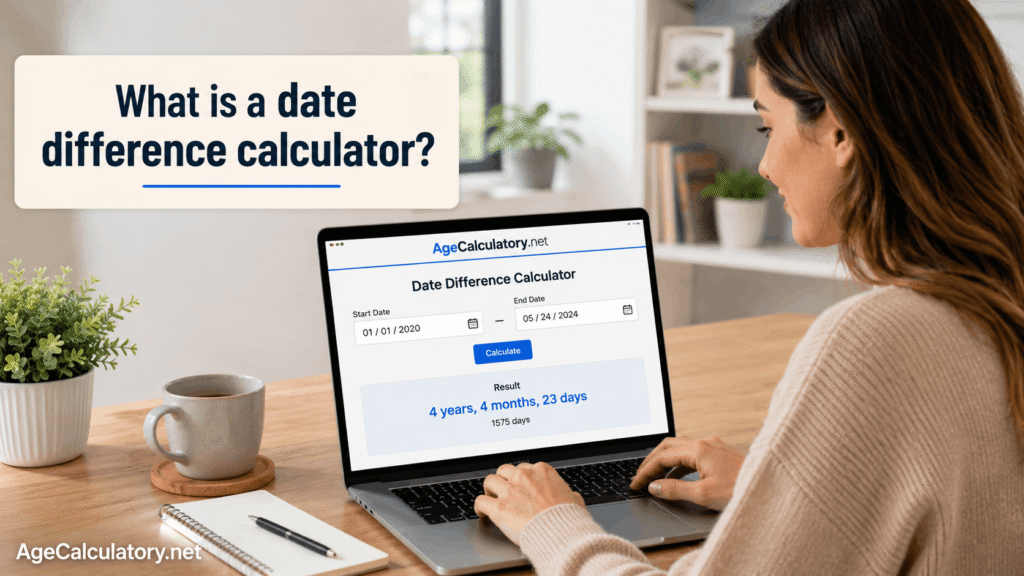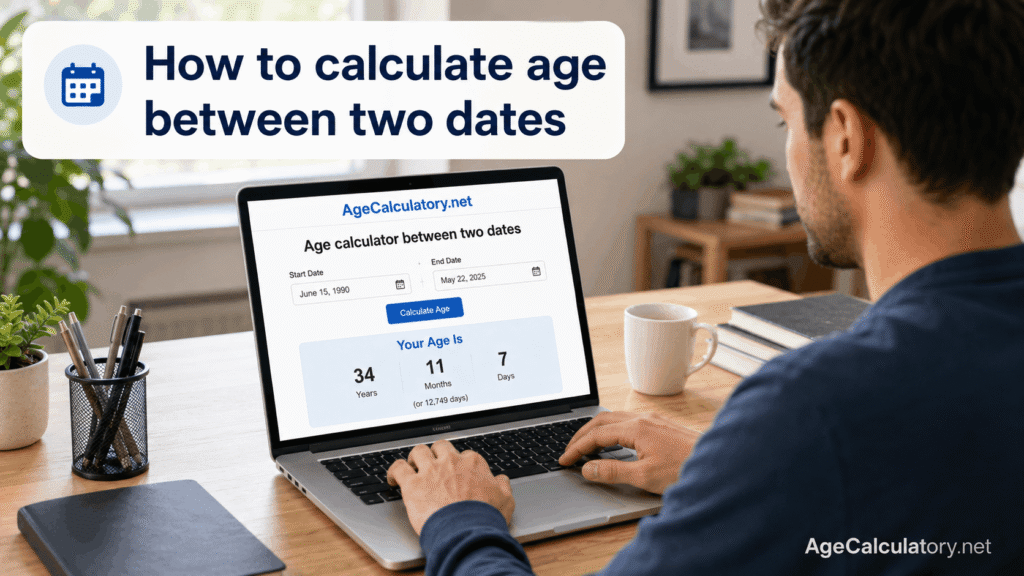
Sometimes you don’t want to calculate age only from date of birth to today. You may need to calculate age between 2 selected dates.
For example, you may want to know your age on a school admission date, exam cut-off date, job application date, or future birthday. In that case, you need a start date and an end date.
This is where age calculation between 2 dates helps.
What does age between two dates mean?
Age between 2 dates means the time gap between a starting date and an ending date.
The starting date is usually the date of birth. The ending date can be today or any date you choose.
For example, if the date of birth is 15 May 1999 and the target date is 27 December 2024, the age between those 2 dates is 25 years, 7 months, and 12 days.
Where this calculation is used
This calculation is useful when a form asks for age on a fixed date. Many schools, exams, and jobs use cut-off dates.
A school may ask the child’s age as on 31 March. An exam may ask the candidate’s age as on 1 August. A job notification may ask age as on 1 January.
So the ending date matters. Using today’s date every time can give the wrong result.
Dates you need
You need 2 dates to calculate age between 2 dates.
The first date is the start date. In most cases, this is the date of birth.
The second date is the target date. This is the date up to which you want to calculate age.
Example:
Start date: 15 May 1999
Target date: 27 December 2024
Basic age calculation logic
The basic logic is:
Age = Target date – Start date
The result is usually shown in years, months, and days.
A proper age calculator checks the full date. It looks at the year, month, and day, then gives the completed time between both dates.
Simple example
Take this example.
Start date: 15 May 1999
Target date: 27 December 2024
From 15 May 1999 to 15 May 2024, there are 25 completed years.
From 15 May 2024 to 15 December 2024, there are 7 completed months.
From 15 December 2024 to 27 December 2024, there are 12 days.
So the age between the 2 dates is:
25 years, 7 months, 12 days
Example when the birthday has not passed
Now take another example.
Start date: 10 December 2000
Target date: 5 March 2026
If you subtract only the years, you get 26. But the birthday on 10 December has not arrived in 2026.
So the person has completed 25 years. The remaining months and days are counted from 10 December 2025 to 5 March 2026.
This is why the full date matters.
Example with a future target date
You can also calculate age for a future date.
Example:
Date of birth: 20 June 2005
Target date: 1 January 2030
This can help you know your age on a future exam date, job date, birthday, or personal milestone.
Future date calculation is helpful when you are planning ahead.
Age between two dates for school admission
School admission rules often use a cut-off date.
For example, a school may say the child must complete 3 years by 31 March 2026.
If the child was born on 10 April 2023, the child has not completed 3 years by 31 March 2026. The birthday comes after the cut-off date.
A few days can change the result, so use the exact cut-off date.
Age between two dates for exams
Many exams have age limits.
The notification may say age should be calculated as on 1 January, 1 July, or 1 August of a certain year.
Use that date as the target date. Then compare the age result with the official age rule.
Also check age relaxation rules if they apply. The calculator gives the age. The notification gives the final eligibility rule.
Age between two dates for jobs
Job applications also use fixed age dates.
Some jobs ask for minimum age. Some ask for maximum age. Some jobs give age relaxation for certain categories.
Enter your date of birth as the start date and the job notification’s cut-off date as the target date. Then check the result carefully.
How to calculate it manually
To calculate manually, write both dates clearly.
First, count the completed years between the start date and target date. Then count the completed months after the last completed year. Then count the remaining days.
This method works well for normal dates. It can become confusing when the dates are near the end of a month.
Why manual calculation can be tricky
Months have different lengths.
January has 31 days. April has 30 days. February has 28 days in a normal year and 29 days in a leap year.
So when you calculate between dates like 31 January and 28 February, the result needs careful counting.
This is why online date calculators are faster for exact results.
How leap years affect the result
Leap years affect date calculation because they add one extra day in February.
This mostly matters when calculating total days, total weeks, or date gaps that include February 29.
People born on February 29 may need extra care for official rules. For school, exam, or job use, follow the rule given by the concerned authority.
Age in years, months, and days
The most common result format is years, months, and days.
Example:
25 years, 7 months, 12 days
This format is easy to read and works well for most users.
It shows completed years first, then completed months, then remaining days.
Total days between two dates
Sometimes you may want the total number of days between 2 dates.
For example, from one date to another, the result may be 9,357 days.
This is helpful for milestones, baby tracking, birthday posts, and personal records.
Total months between two dates
Total months can help with child age, school admission, and forms.
For example, 4 years and 7 months equals 55 months.
This format is common for young children because months give a closer age than years.
Total weeks between two dates
Total weeks are useful for babies, health notes, and short date gaps.
The calculator counts total days first. Then it divides the total days by 7.
If extra days remain, the result can be shown as weeks and days.
Common mistakes
One common mistake is using today’s date when the rule gives a different target date.
Another mistake is subtracting only the years. That can give the wrong result if the birthday has not passed.
Some people also enter the date in the wrong format. For example, 05/10/2000 can mean 5 October or 10 May, depending on the format used by the website.
How to avoid wrong results
Use the full date: day, month, and year.
Check the target date before calculating. If you are using the result for a form, use the date given in that form.
Use a date picker when possible. It reduces mistakes with date format.
Use AgeCalculatory.net
You can use AgeCalculatory.net to calculate age between 2 dates.
Enter the start date and target date. The tool can show the result in years, months, and days.
If the tool supports extra results, you may also see total months, total weeks, and total days.
Frequently asked questions
What does age between two dates mean?
It means the time difference between a start date and a target date. The result is usually shown in years, months, and days.
How do I calculate age between two dates?
Enter the start date and target date. Then count completed years, completed months, and remaining days between those dates.
Can I calculate age for a future date?
Yes. You can use a future date as the target date and check age on that date.
Why should I use a target date?
A target date is needed when a school, exam, job, or form asks for age as on a fixed date.
Does leap year affect age between two dates?
Yes. Leap years can affect total days and exact date gaps because leap years have 366 days.
Can I use this for school admission?
Yes. Enter the child’s date of birth and the school’s cut-off date to check the age.
Can I use this for job or exam eligibility?
Yes. Use the cut-off date given in the official notification, then compare the result with the age rule.
Is this result official proof?
No. The result is for checking and personal use. For official proof, use accepted documents like a birth certificate, school certificate, passport, or government ID.
Conclusion
Calculating age between 2 dates helps when today’s date is not the date you need.
It is useful for school admission, exam eligibility, job applications, future planning, and personal records.
Use the Date Difference Calculator on AgeCalculatory.net to calculate age between 2 dates in years, months, and days without manual counting mistakes.